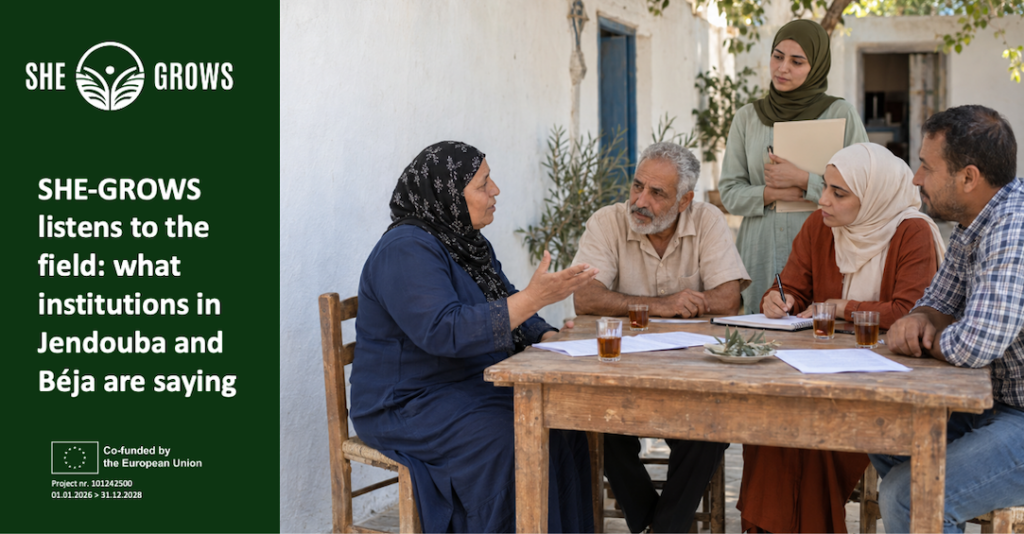
Before designing any training for rural women in Tunisia, the SHE-GROWS project set itself an uncomfortable question: do we actually know what is holding these women back? The European consortium has developed aresearch framework that will guide fieldwork in the regions of Béja and Jendouba throughout 2026.
The survey had already made one thing plain. For 82 per cent of respondents, farming is the household’s main sourceof income, in a region where water shortage has stopped being a seasonal setback and become a permanentcondition. The stakeholder consultations, led by Tunisian partner Grow It Yourself, set out to understand why, againstsuch an obvious need, the support offered so far has struggled to reach the people it was meant for.The most frequent answer is also the most practical one: transport. Almost every interviewee named it as the singlebiggest obstacle. Not a shortage of courses, not a shortage of willingness, but the sheer difficulty of getting there.
Many women have no vehicle of their own and cannot absorb the cost of travelling to centres far from their villages.Hatem Ennaoui, who represents the training centre for the North West region, puts it plainly: even where goodtraining exists, the women who need it most cannot reach it. The operational conclusion follows on its own. Traininghas to travel to the communities rather than the other way round.The second finding concerns knowledge of the technique itself. The survey recorded that 73 per cent of respondentshad never heard of hydroponic farming. The interviews gave that figure an unexpected face.
Haifa Mediouni,Secretary General of an agricultural development association in Jendouba, a graduate who has worked in the sectorfor years, said she had never come across hydroponics until this project. If the information has not reached the peopleworking in rural development, awareness-raising is not a box to tick early on. It is a substantial part of the work.
The third finding shifts attention to what happens afterwards. Olfa Lafi, Head of Department at the Tunisian Union ofAgriculture and Fisheries (UTAP) in Béja, points out that the real barrier is not the course but the day after it ends,when a newly acquired skill finds nothing to turn it into a livelihood. The survey had flagged that only 40 per cent ofthose reached have access to a market for their produce, and recorded access to credit that looks broader on paperthan the consultations suggest it is in women’s daily experience. Lafi also offers a direction: pair production withprocessing and marketing, following the example of the medicinal and aromatic plants already developed in the Nefzaarea.
One insight could not have come from the survey at all, because it concerns supply rather than demand. MoniaBouaziz, who heads the Livestock and Pasture Office for Jendouba and Béja, notes that the region already has theequipment and the infrastructure, and that what it lacks are trainers capable of passing on modern techniques. Shealso identifies a promising group to start with: young women graduates who are out of work and still drawn toagriculture.Not every voice points the same way, which is no bad thing.
Sofiane Rezgui, Vice President of UTAP in Béja, argues forintroducing hydroponics as a complementary technique, tuned to his region’s cereal-growing character rather thantransplanted from models designed elsewhere. On course format, survey preferences leaned towards distancelearning, while the practitioners consulted locally press for hands-on work and live demonstration. The project willanswer that difference of perspective with a blended pathway: short modules that work on a phone, alongsidepractical sessions held in the villages.Both strands of research now feed into a single mapping report led by OpenCom, which will turn these findings intothe design of the training pathway.
SHE-GROWS is coordinated by EFA El Soto in Spain, with partners in Italy, theCzech Republic and Tunisia.