In our first edition we explained why the project begins by listening. This is what we heard. Between April and July, the Tunisian partners collected more than a thousand questionnaires and met women, men and local institutions across the governorates of Béja and Jendouba, in north-western Tunisia. Rural women have no shortage of motivation, and they know the land well. What is missing is a way of turning that knowledge into work that brings in a steady income. That is the gap the project now has to close.
Hydroponics and cooperation for rural women in Tunisia
SHE-GROWS (Sustainable Hydroponic Education for Growing Rural Opportunities) is a three-year project funded by the European Union through Erasmus+. It belongs to the programme's Capacity Building strand, which supports vocational education and training (VET) in countries outside the EU.
The project will train 60 people from the governorates of Béja and Jendouba, at least half of them women, in hydroponic growing (cultivation without soil, using nutrient solutions and making more efficient use of water) and in running a cooperative. The end goal is a legally constituted women's agricultural cooperative, together with a dual qualification recognised in both Europe and Tunisia.
Before designing the course, the consortium set out to get to know the people it is meant to serve. These are the numbers behind the research.
From the field to the report in five months
The fieldwork was carried out by the three Tunisian partners (ELEMTIEZ; UTAP, the Tunisian Union of Agriculture and Fisheries; and Grow It Yourself, or GIY), with scientific coordination from the Italian cooperative OpenCom. The main stages are covered in articles on the project website.
Four lessons for anyone designing training
For 81.7% of respondents, farming is the household's main source of income. Beyond that shared reliance on farming, the report finds no typical 'rural woman'. Circumstances vary widely, and some of the differences between women and men are surprising.
Training has to go where women live
Only 20.1% of respondents have ever taken a vocational or non-formal course. More than half of the women cite the distance to a training centre or the cost of getting there as an obstacle, compared with fewer than one man in four. The cost of courses and materials weighs on 30.3% of women and 10.2% of men. Online learning has its limits too, since more than a third of respondents have no digital device, and women are more likely to prefer face-to-face courses or sessions in their own village.
Among the women reached, interest in hydroponics runs high
Of the women surveyed, 43.5% had already heard of it, against 15.9% of the men, and 83.7% say they are at least moderately interested in learning more. But interest is not the same as readiness. In the women's focus group the main obstacles were, in order, a lack of capital and a lack of water.
Cooperatives: plenty of appetite, little experience
Today just 10.5% of respondents belong to any collective organisation. Yet 44.3% of women say they are 'very ready' to join a new cooperative, against 8.1% of men. Stated willingness far outstrips experience. For a cooperative to hold together it needs clear, shared rules, a fair split of earnings and women who take a real part in decisions, including those about money.
Women and men: gaps that run both ways
Women report less access to land (82.2% against 89.2%) and to credit, but more access to digital devices (73.0% against 59.0%) and to agricultural markets (57.5% against 28.1%). Having access to a resource, however, does not always mean deciding how it is used. Family dynamics, freedom of movement and the time left after caring for others all play a part.
Knowledge that is already there
The interviews brought a number of recurring practices to light, which the report distils into four anonymised cases. Here are two of them.
One watering, two harvests
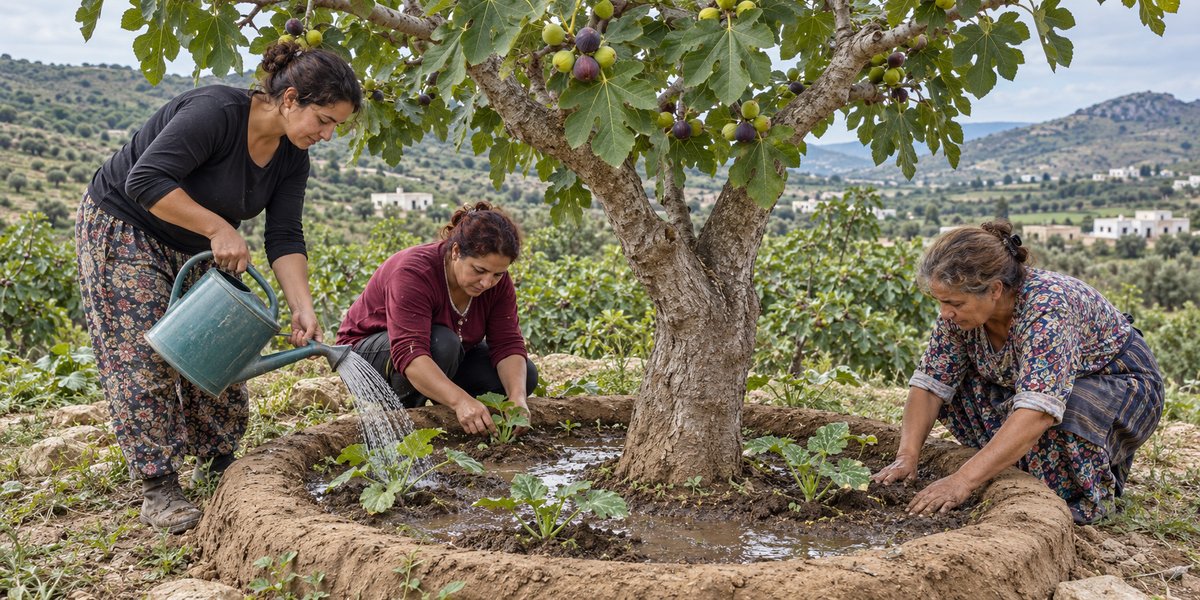
In fig orchards, a practice that comes up repeatedly is to sow cucurbits (the family that includes courgettes and melons) inside the irrigation basins around the trees. The same water serves two crops, and the aim is to lose less of it to evaporation from the wet soil. Women also use local seed and replace heat-sensitive crops with ones they see as better able to cope.
From course to income, the missing link
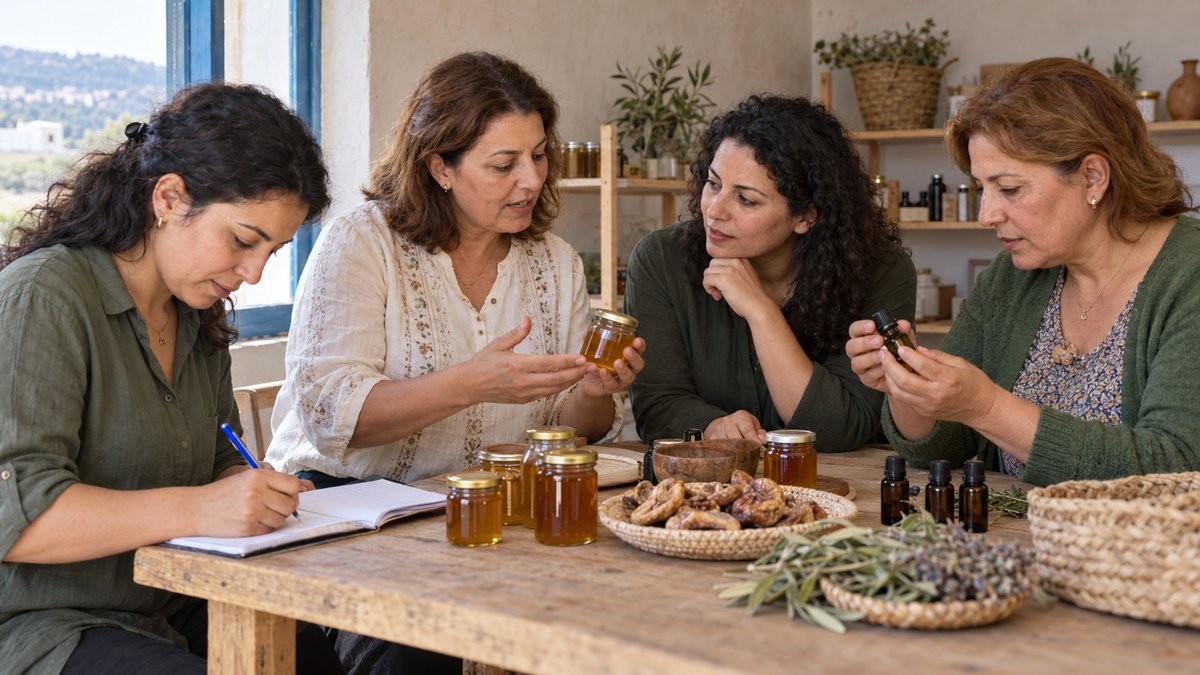
Several women have already taken short courses in beekeeping, distilling aromatic plants, cheese-making or drying figs, and say the quality of their products has improved. But some groups have no stills or incubators of their own and sometimes borrow them from neighbouring groups, while those who produce honey, essential oils, processed figs or cheese struggle to sell without permanent outlets.
For the project, two things follow. Hydroponics should sit alongside the adaptation practices women already use, rather than try to replace them. And a course that ends with a certificate, but without equipment, follow-up support or a route to market, risks changing very little.
The course now being designed
According to the report, installing a system or running a course is not enough on its own. Hydroponics is most likely to become a realistic option when five conditions are met at once.
- The site and the system are technically suitable.
- Costs and financing are clear and proportionate to the risk women can bear.
- Training is practical, close to home and followed up with technical support.
- The crops chosen have a genuine market.
- Women have a real say over resources, labour, the running of the cooperative and earnings.
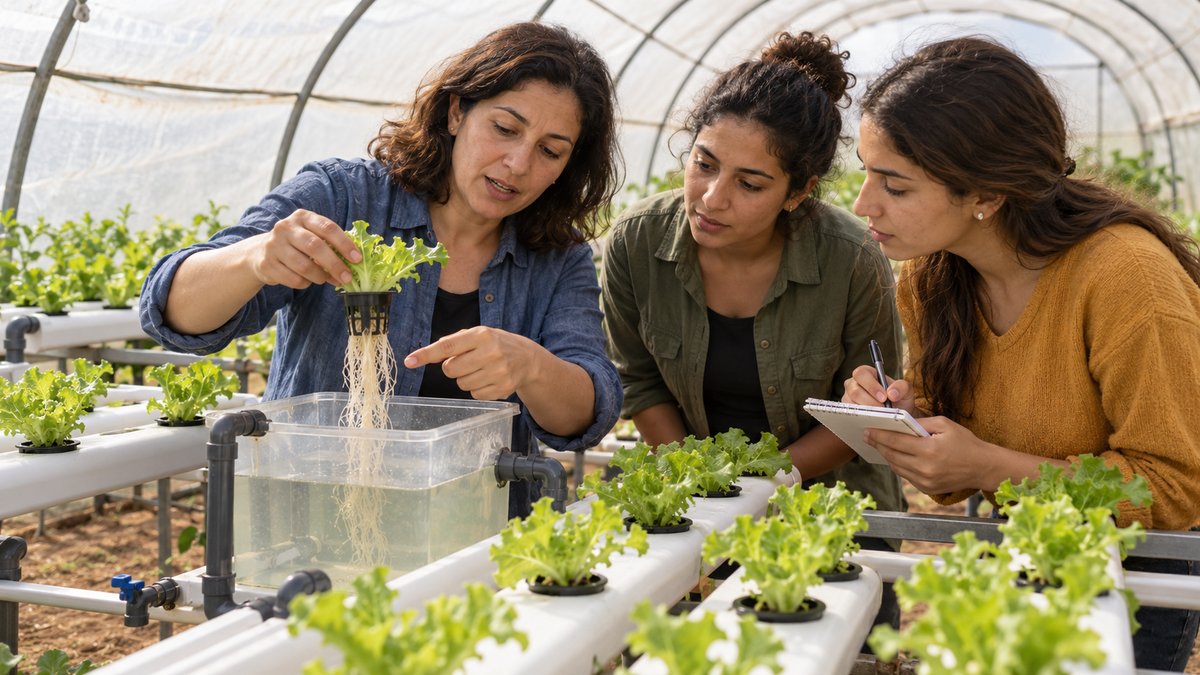
Since August the partners have been turning these findings into the programme for the course 'Hydroponic agriculture and sustainable entrepreneurship'. EFA El Soto, the Spanish agricultural training organisation that coordinates the project, is leading work on the learning outcomes (what participants should be able to do by the end) and on how the dual qualification will be certified. The Czech training centre Libverda is developing the system for assessing skills.
The report recommends a programme that combines hydroponic techniques, water management and climate adaptation, entrepreneurship and financial literacy, market access and cooperative management. Teaching should mix classroom and remote learning, with plenty of hands-on practice on site and simple materials that can be used on a phone. It should also continue after the course, through supervised practice, demonstration units and mentoring. The partners are now building on these recommendations.
The way results are measured needs rethinking too. Enrolment figures are necessary but not enough on their own, so the report suggests tracking progress in stages.
Read the full report
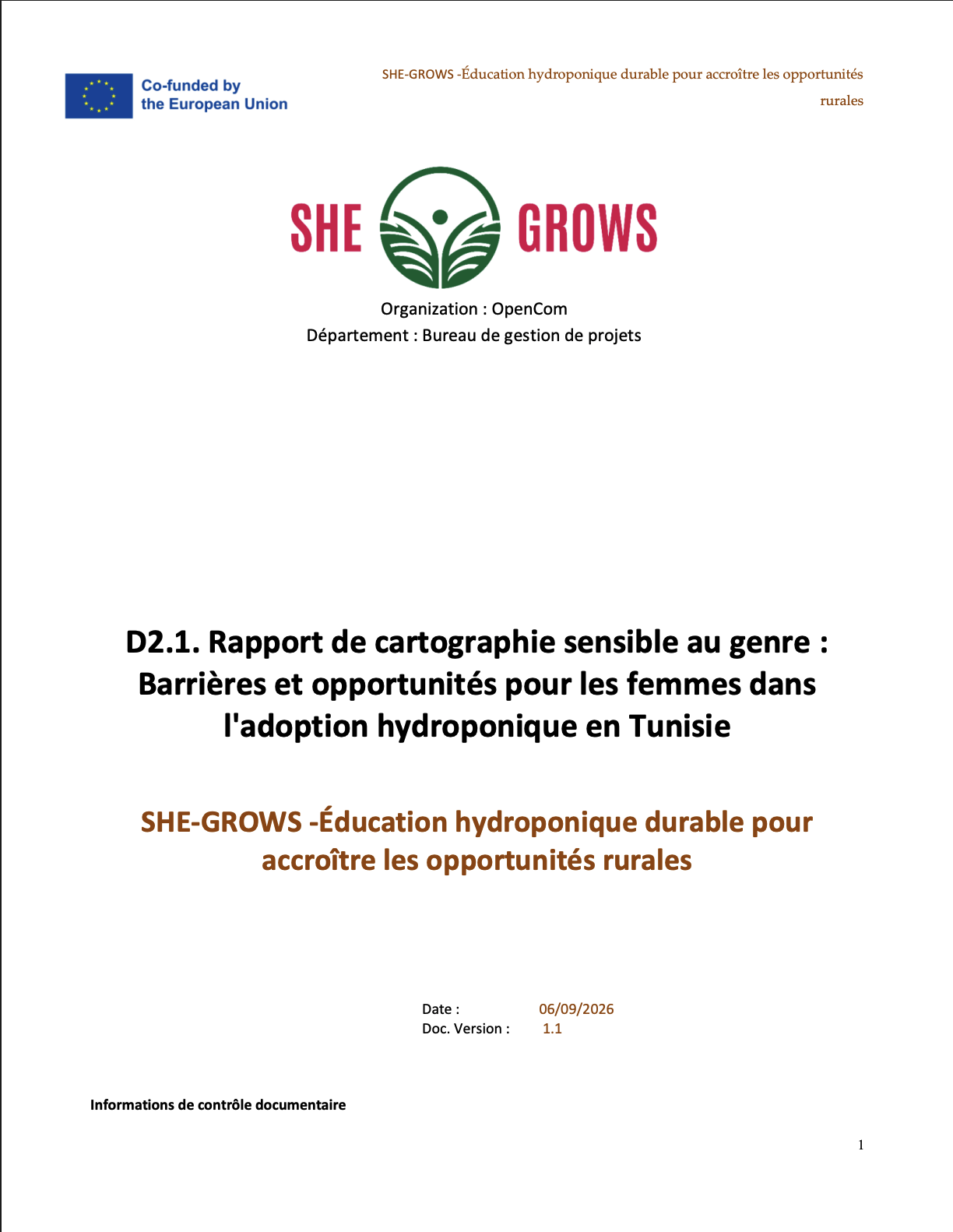
The report contains the full data broken down by gender, a map of the institutions involved and recommendations for the project's next stages.
Six organisations, four countries
ATFP, the Tunisian vocational training agency (Agence Tunisienne de la Formation Professionnelle); APIA, the agricultural investment promotion agency (Agence de Promotion des Investissements Agricoles); AFRJ, a rural women's association in Jendouba (Association Femme Rurale Jendouba).